Application Modernization

Modernize legacy applications without migrating the past.

Five connected areas of expertise — application modernization, API and integration, cloud engineering, low code and AI-driven quality engineering — that take legacy estates from analysis to modern, maintainable systems in production.

Application Modernization
Intro

From legacy complexity to measurable modernization impact

Most organizations do not struggle because they lack applications. They struggle because they have too many, too old, too complex or too expensive to evolve.

Our approach starts somewhere different: requirements.

We work across the full modernization estate: the applications themselves, the integrations that connect them, the cloud platforms they run on, the low-code layers that accelerate delivery, and the quality engineering that proves it all works. And where a legacy system has become its own only documentation, we apply AMA, our AI-driven modernization approach, to rebuild from validated requirements rather than converted code.

Areas of expertise

What the capability covers

Five areas of expertise that work together, or independently, depending on where the estate needs to move first.

01

Application Modernization

Legacy applications rebuilt as modern, maintainable systems — simplified, documented and ready to evolve.

We assess the portfolio, decide what to retain, consolidate, replace or retire, and modernise from validated business behaviour instead of converted code.

Portfolio assessmentRearchitectureLegacy decommissioningModernization roadmap
02

API and Integration

The connective layer between applications, partners and channels, designed as a governed product rather than point-to-point plumbing.

We design and build API-led and event-driven integration on platforms such as MuleSoft, replacing batch interfaces and brittle middleware with reusable, observable services.

API-led architectureEvent-driven integrationMuleSoftLegacy middleware migration
03

Cloud Engineering

Modern applications need a platform that matches them — scalable, automated and cost-aware from day one.

We design landing zones, containerised workloads and CI/CD pipelines, and migrate applications to cloud with infrastructure as code, observability and FinOps controls built in.

Cloud migrationContainers and KubernetesInfrastructure as codeDevOps and CI/CD
04

Low code

Where speed matters more than bespoke engineering, low code delivers working software in weeks.

We use low-code platforms to build front ends, workflows and departmental applications quickly, governed by the same architecture and security standards as the rest of the estate.

Rapid application deliveryWorkflow automationCitizen developer enablementPlatform governance
05

AI-driven Quality Engineering

Quality proven continuously and automatically, not sampled manually at the end of a release.

We build automated test suites, use AI to generate and maintain test cases from requirements, and run legacy and modern systems in parallel to compare outputs before cutover.

Test automationAI-generated test casesParallel executionContinuous quality
What we solve

The real barriers to application modernisation

01

Legacy complexity

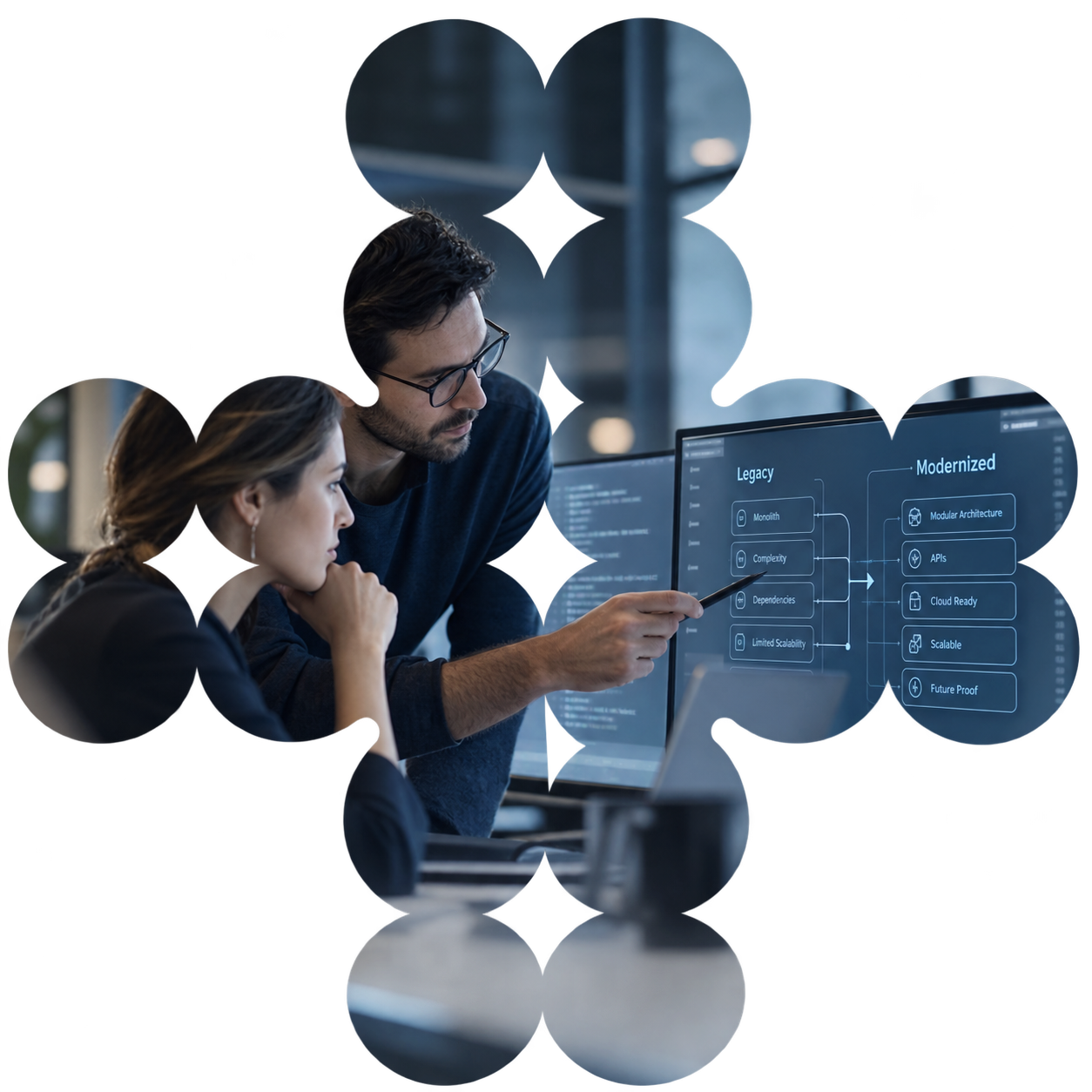
Legacy portfolios are often built over many years of incremental change. Applications become large, rigid and difficult to evolve. Business logic is scattered across code, integrations and manual workarounds, making every transformation initiative slower and riskier.

02

Technical debt and maintenance cost

As applications age, maintenance effort increases. Teams spend too much time keeping systems alive instead of building new capabilities. This limits innovation, consumes budget and makes IT less responsive to business change.

03

Direct code conversion

Many modernisation programmes focus on converting legacy code into newer technologies. This may refresh the stack, but it often creates a modern application that remains heavy, complex and expensive to maintain. We avoid this trap by modernising from validated business requirements rather than line-by-line conversion.

04

Lack of functional knowledge

In many legacy environments, the application itself has become the only reliable source of truth. Documentation is outdated, business rules are hidden in code, and key knowledge depends on a small number of people. We recover that knowledge through AI-assisted requirements discovery.

05

Migration risk

Critical applications cannot simply be replaced without proof. We reduce risk through automated testing, parallel execution and output comparison between the legacy and new systems.

06

Slow delivery

Traditional modernisation can take too long to show value. Combining requirements engineering, AI-assisted development and automated tests shortens the path from legacy analysis to modern application delivery.

In their words

App Modernization

How we create value

Five outcomes

Cleaner application portfolios

We help organisations reduce duplication, consolidate functionality and simplify application landscapes.

Fewer redundant applicationsLower infrastructure complexitySimpler integrationsClearer architecture

Faster delivery

AI-assisted engineering and automated testing accelerate development cycles and reduce manual effort.

Faster time to marketShorter development cyclesMore predictable deliveryGreater responsiveness to business change

Reduced technical debt

Modernisation starts from business behaviour and validated requirements, not from legacy code conversion.

Cleaner architectureLess obsolete functionalityLower maintenance effortBetter long-term scalability

Lower delivery risk

Parallel execution, automated tests and output comparison help prove functional accuracy before full transition.

Safer migrationReduced cutover riskGreater confidence from business and ITStronger governance

Better business agility

When requirements become the strategic asset, applications become easier to evolve.

Faster adaptation to changeBetter alignment between IT and businessMore maintainable systemsA stronger foundation for AI enabled operations
AMA approach

AMA

AI driven Application Modernization Approach

AMA is Linkroad’s structured approach to modernising legacy portfolios through enterprise architecture, requirements engineering, AI-assisted development and automated validation.

It is designed to help organisations simplify applications, reduce technical debt and create modern systems that are easier to maintain, evolve and scale.

What AMA actually does

Seven capabilities, applied in sequence or on their own, depending on where the portfolio needs to move first.

01
01

Portfolio analysis and modernization roadmap

We help organizations identify which applications should be retained, modernized, consolidated, replaced or retired.

This creates a clear modernization roadmap based on business value, technical risk, architectural complexity and operational impact.

02
02

Requirements discovery powered by AI

AMA analyses user sessions, documentation and legacy source code to reconstruct the real behaviour of an existing application.

This turns hidden business logic into explicit, usable and validated requirements before development begins.

03
03

Automated requirements validation

AI interacts with the legacy system to confirm that each requirement reflects the current behaviour of the application.

This helps reduce ambiguity and creates a stronger foundation for modernisation.

04
04

Spec-driven development

Validated requirements are used to generate modern architecture, application code and automated test suites.

This makes development cleaner, more controlled and less dependent on legacy implementation details.

05
05

Automated testing and parallel execution

The new application runs side by side with the legacy system while outputs are automatically compared.

This gives teams a safer way to prove functional equivalence before replacing or scaling the new system.

06
06

Requirement-driven evolution

Future changes can be managed by updating requirements and regenerating code while keeping the architecture clean.

This changes the maintenance model from reactive code modification to structured requirement-driven evolution.

07
07

AI operation first applications

AMA does not only modernise technology. It helps rethink how applications should operate in an AI-enabled environment.

New applications can be designed to support AI agents, automate high-volume operational workflows and escalate only complex exceptions to human teams.

AMA methodology

How AMA works

Five steps that turn an existing application into validated requirements, and those requirements into a modern system you can prove.

1

Discover requirements

AMA analyses user sessions, documentation and legacy source code to reconstruct how the application really works.

2

Validate requirements

AI interacts with the legacy system to confirm that each requirement accurately reflects current behaviour.

3

Generate code and tests

Validated requirements are used to generate modern architecture, application code and automated test suites.

4

Run in parallel and validate

The new system runs side by side with the legacy application. Outputs are compared automatically to validate functional equivalence.

5

Update requirements and regenerate

Future evolution happens by updating requirements, allowing AI-assisted regeneration while keeping the architecture clean.

From legacy behaviour to validated requirements to a modern application.

Proof points

Why organisations modernise with us

A proprietary approach, expert teams in the loop, and validation built into every stage of delivery.

Requirements-first modernisation

Modernisation starts with business behaviour and validated requirements, not with legacy code.

Proprietary approach

AMA combines methods, software and AI agents into a structured modernisation engine.

Human in the loop

AI accelerates discovery, engineering and validation, while expert teams ensure quality, governance and architectural consistency.

Parallel validation

Legacy and modern systems can run side by side to compare outputs and reduce migration risk.

Automated tests from day one

Generated functionality includes automated tests from the beginning, improving reliability and maintainability.

Portfolio simplification

AMA supports consolidation opportunities across legacy portfolios, reducing duplication and long-term operational complexity.

Success stories

Where we impact

Digital transformation with LeanIX
Case study

Digital transformation with LeanIX

Applications, integrations and technology components brought under one governed portfolio, with SAP LeanIX as the platform.

Explore the case
BizTalk to MuleSoft
Case study

Migrating a legacy BizTalk estate to MuleSoft

A legacy BizTalk integration estate rebuilt on MuleSoft, with integration flows reconstructed rather than converted.

Explore the case
Real-time inventory visibility
Case study

Real-time inventory visibility

Event-driven integration replacing batch processing, so stock levels are visible across channels as they change.

Explore the case

Do not migrate the past. Build the future.

Modernisation should not replicate legacy complexity in a new technology stack. It should create applications that are leaner, easier to evolve and ready for the next generation of AI-enabled operations.