Articles
Barometer of the State of Mathematical Optimization

Find out how large companies are handling complex decision-making, and what role mathematical optimization plays in their transformation.
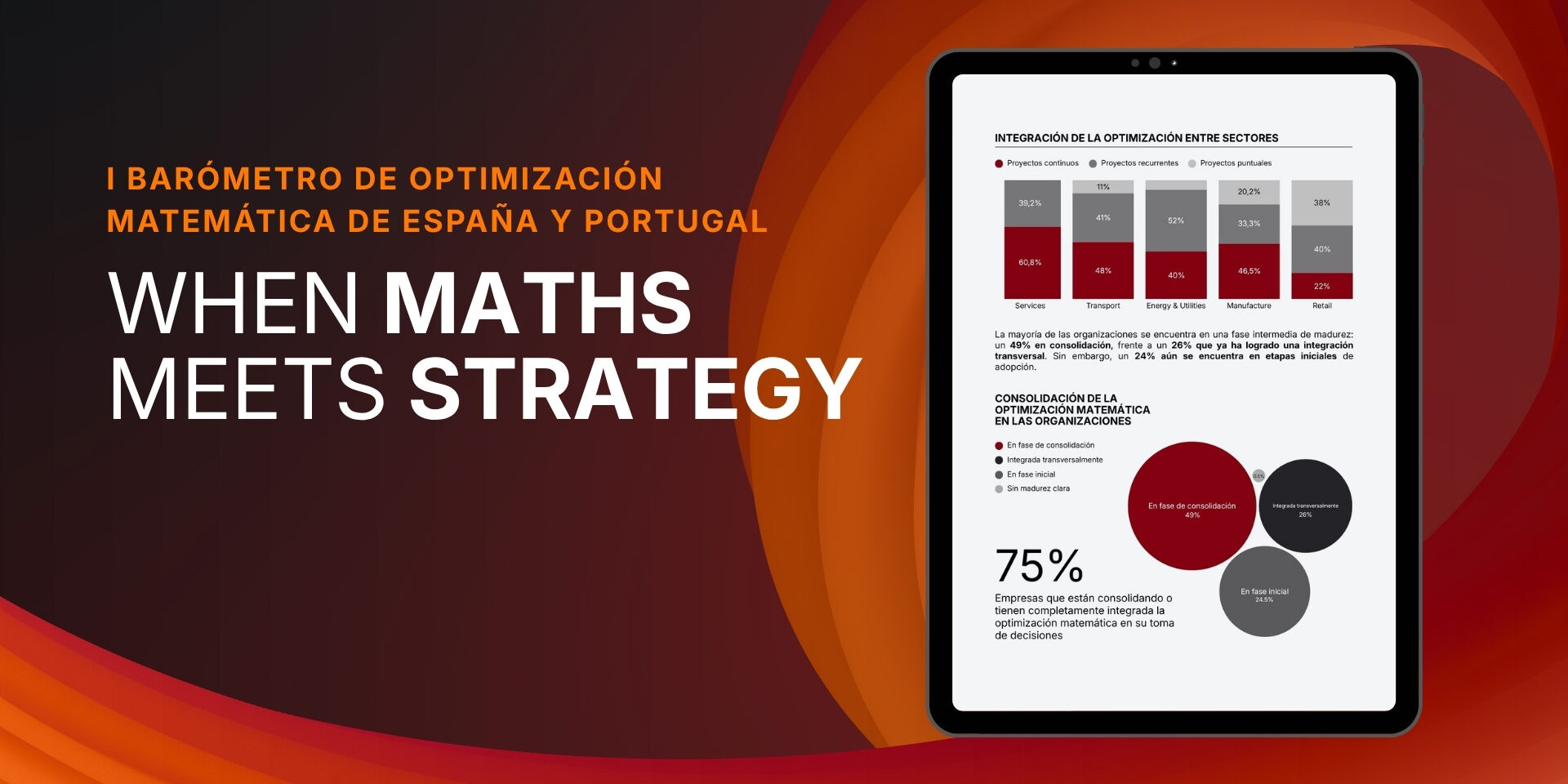
In this study, produced by DECIDE | Linkroad in collaboration with Gurobi, we analyse the real state of mathematical optimization — prescriptive AI — in large companies across Spain and Portugal.
Drawing on the responses of more than 400 executives, the report offers a clear picture of how decisions are actually made today, how much room for improvement exists and what the real level of adoption of prescriptive AI is.
Key insights
- 98.5% of companies identify room for improvement in costs and efficiency
- 84% still make complex decisions without advanced tools
- 1 in 4 uses mathematical optimization internally
- 97% expect a return from these solutions
- 1 in 5 points to strategic prioritisation as the main barrier
| 98.5% of companies identify room for improvement in efficiency, but only 1 in 4 uses prescriptive AI to make decisions. |
A gap between awareness and practice
The numbers point to a clear gap. Almost every organisation recognises that it could operate more efficiently and at a lower cost, yet the vast majority continues to make its most complex decisions — planning, scheduling, allocation of resources, distribution, capacity — supported by spreadsheets, experience and manual judgement.
This is not a matter of lack of ambition. It is a matter of the tools available at the moment the decision has to be made. When the number of variables, restrictions and possible scenarios grows beyond what a team can reasonably compare, intuition stops being an advantage and starts being a limitation.
Prescriptive AI answers a different question
Much of the current conversation around artificial intelligence focuses on predicting what will happen or generating content. Mathematical optimization answers a different question: given everything we know, and given every restriction we have to respect, what is the best possible decision?
Predictive AI tells you what is likely to happen. Prescriptive AI tells you what to do about it.
The two are complementary. Forecasts, machine learning models and generative AI feed the decision; optimization turns that information into a plan that respects real-world constraints and measurably improves the outcome.
The main barrier is not technology
One of the most revealing findings of the barometer is that the greatest obstacle to adoption is not cost, nor the maturity of the technology, nor the lack of data. One in five organisations points to strategic prioritisation: optimization simply does not yet appear high enough on the agenda.
This is significant when read alongside another figure: 97% of companies expect a return from these solutions. Expectation exists. What is often missing is an internal sponsor, a first use case with a clear scope and a way of measuring the impact.
What you will find in the report
The study analyses six key dimensions:
- Room for improvement in efficiency and costs
- How decisions are made today
- Business impact and expectations of return
- Level of adoption of optimization
- Relationship with AI, machine learning and GenAI
- Level of organisational maturity
Together, these dimensions offer a realistic benchmark: where your organisation stands compared with more than 400 executives in Spain and Portugal, and which step makes sense to take next.
| The competitive advantage is no longer in having the data. It is in deciding better with it. |